

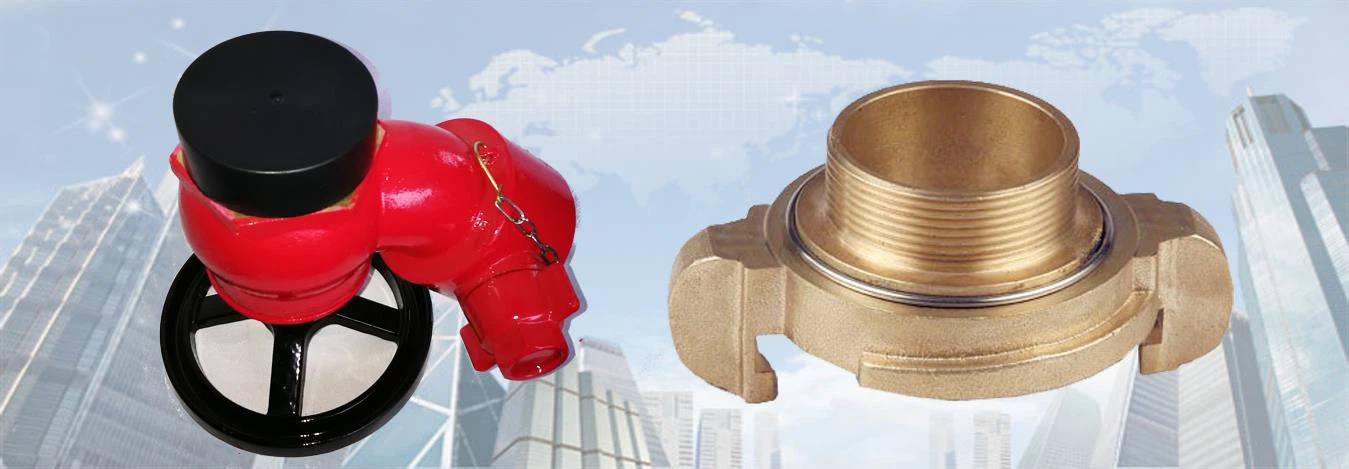
Fire Hose Couplings
Product introduction of Fire hose diffuser nozzle Our diffuser branchpipe nozzle is supplied as a 'short' standard and long branchpipe pattern version with a integral 64mm instantaneous alloy male inlet (it can be also be supplied with other inlets on request). Using the nozzle is easy by holding the rubber ring - the rubber ring is handy protection if you drop the nozzle - and twisting it from off to jet to spray to wide spray curtain.
What Is Fire Hose Couplings
A fire hose coupling is a device used to connect two sections of fire hose together. It ensures a secure and leak-free connection, allowing for the efficient flow of water or other fire suppressants. The coupling consists of two parts: the male coupling and the female coupling.
Advantages of Fire Hose Couplings
Superior Durability and Strength
The Fire Hose Coupling is an essential tool for firefighters and emergency responders to connect hoses to hydrants or other hoses. Made of high-quality aluminum or brass, these couplings are built to withstand the rigors of extreme heat, pressure, and wear. With a rugged construction, they are corrosion-resistant, rustproof, and have a long service life. These couplings provide a tight and secure fit that ensures maximum water flow and pressure, making them ideal for fire suppression and other high-pressure water applications.
Easy to Use and Interchangeable
The Fire Hose Coupling is designed to be easy to use and interchangeable, making it convenient for firefighters and emergency responders to connect hoses quickly and efficiently. The couplings are available in a variety of sizes and configurations, allowing users to connect hoses of different sizes and types. The couplings are equipped with locking mechanisms that prevent accidental disconnection and ensure a tight seal. With a quick-release mechanism, the couplings can be easily disconnected in case of an emergency, making them a reliable and efficient tool for firefighting and other emergency situations.
Versatile Applications
The Fire Hose Coupling has a wide range of applications beyond firefighting and emergency response. They can be used in agriculture, mining, construction, and other industries where high-pressure water delivery is required. These couplings are compatible with a variety of hoses, including PVC, rubber, and lay-flat hoses. They are also suitable for use in marine environments, as they are resistant to saltwater corrosion. With their versatility and adaptability, Fire Hose Couplings are an essential tool for any industry that requires high-pressure water delivery.
-
![Russian Fire Hose Coupling]() Russian Fire Hose Coupling1.Product introduction Gost couplings are made in compliance with Russian norm which used mainly in Russia, Cuba, Lithuania, and neighboring countries. They are provided with hose shank, threaded,...read more
Russian Fire Hose Coupling1.Product introduction Gost couplings are made in compliance with Russian norm which used mainly in Russia, Cuba, Lithuania, and neighboring countries. They are provided with hose shank, threaded,...read more -
![Italy Type Fire Hose Coupling]() Italy Type Fire Hose Coupling1.Product introduction of Italy type fire hose coupling UNI 70 Italian Market Kind Fire Hose Coupling 2.Product Parameter A.UNI 70 Italian Fire Hose Coupling Features B. Italian UNI Fire Fitting...read more
Italy Type Fire Hose Coupling1.Product introduction of Italy type fire hose coupling UNI 70 Italian Market Kind Fire Hose Coupling 2.Product Parameter A.UNI 70 Italian Fire Hose Coupling Features B. Italian UNI Fire Fitting...read more -
![Storz Suction Hose Coupling]() Storz Suction Hose Coupling1.Product introduction Used for connecting fire hose, PVC pipe and other low pressure pipes in the fire brigade, industry, refinery, building industry, agriculture, shipping, military and civil...read more
Storz Suction Hose Coupling1.Product introduction Used for connecting fire hose, PVC pipe and other low pressure pipes in the fire brigade, industry, refinery, building industry, agriculture, shipping, military and civil...read more -
![Instantaneous Fire Hose Couplings]() Instantaneous Fire Hose Couplings1.Product introduction of Instantaneous Fire Hose Couplings Instantaneous Fire Hose Couplings are commonly used by the Fire department for the delivery of water to fire fighting systems but are...read more
Instantaneous Fire Hose Couplings1.Product introduction of Instantaneous Fire Hose Couplings Instantaneous Fire Hose Couplings are commonly used by the Fire department for the delivery of water to fire fighting systems but are...read more -
![Machino Fire Hose Coupling]() Machino Fire Hose Coupling1.Product introduction Machino Fire Fittings are available in 1½” and 2½” options and manufactured in gunmetal to suit the demands of the marine trade providing salt water corrosion resistance and...read more
Machino Fire Hose Coupling1.Product introduction Machino Fire Fittings are available in 1½” and 2½” options and manufactured in gunmetal to suit the demands of the marine trade providing salt water corrosion resistance and...read more -
![Nakajima Delivery Hose Coupling]() Nakajima Delivery Hose Coupling1. Product introduction Japanese Nakajima fire fittings are a range of gunmetal fire fittings comprising 3 different size options, the JIS 65A, JIS 50A and JIS40A. Nakajima (JIS) Fire Fittings are...read more
Nakajima Delivery Hose Coupling1. Product introduction Japanese Nakajima fire fittings are a range of gunmetal fire fittings comprising 3 different size options, the JIS 65A, JIS 50A and JIS40A. Nakajima (JIS) Fire Fittings are...read more -
![ANSI PIN Hose Coupling]() ANSI PIN Hose Coupling1.Product introduction The couplings are a male and female threaded coupling with pin lugs for tightening. They have NST (NH) US style threads or NPSH straight pipe threads as shown. Ansi pin type...read more
ANSI PIN Hose Coupling1.Product introduction The couplings are a male and female threaded coupling with pin lugs for tightening. They have NST (NH) US style threads or NPSH straight pipe threads as shown. Ansi pin type...read more


Why Choose Us
Experienced Team
Our team of engineers and technicians has years of experience in the industry, and we leverage that expertise to provide our clients with the best possible solutions.
Exceptional Customer Service
We pride ourselves on providing exceptional customer service and technical support to our clients, ensuring that they have a smooth and hassle-free experience.
Quality Products
We use only the highest-grade materials and advanced manufacturing techniques to produce products that are reliable, durable, and perform to the highest standards.
Competitive Price
We have professional sourcing team and cost accounting team, stive to reduce cost and profit and provide you a good price.
Sustainable Development
Establish a good reputation and brand value in the industry, and promote the sustainable, stable, rapid and healthy development of the enterprise.
One stop solution
From the begining inquiry and throughout the entire process until you receive the goods. we are dedicated to supporting you every step of the way.
Understanding Fire Hose Couplings and Threading
In order for a fire hose to work safely and effectively, proper coupling selection is essential. A hose coupling is a type of fitting located on the end of the fire hose, which is typically made of steel, brass, or aluminum. The coupling has threading on each end, one female end and one male end, allowing the hose to connect with another hose, tap, or other water source. In order to attach the two threaded devices together, several factors must be considered, such as size, gender, and thread standard. To better understand fire hose couplings and threading, consult this helpful guide.
Coupling Gender
Hose couplings come in three different genders: male, female, and universal. The gender of a hose coupling is easy to determine by looking at its threads. Male coupling has threads on its outside and female coupling has threads on the inside. Universal coupling, on the other hand, can be joined to any other end of the same diameter rather than having a distinct male or female end.
Coupling size
To ensure that your fire hose functions properly, it's important to choose the correct size coupling for your application. To determine the size of the coupling that your hose will require, check the number on the female coupling. Other options for determining the correct size of the required coupling include measuring the diameter of the inside of the male coupling or looking for numbers stenciled on the fire hose.
Thread standards
Understanding the different thread standards of fire hose couplings is essential for properly matching fire hose devices together. While there are many different types of fire hose threads, there are three main types that are most commonly used in fire departments. The most common types of fire hose threading are identified by the initials NH or NST, which refer to national standard thread; NPT, which stands for national pipe threads; and NPSH, which represents national pipe straight hose thread.
To determine what type of thread standard your coupling requires, check for a stamp with the initials of the thread's standards on the female couplings of the hose you plan to replace, the water source adapter, or fitting. In the case that there isn't a stamp in any of those locations, you can determine the thread standard by measuring the male coupling's outside diameter, or circumference.
Reap More Benefits of Fire Hose Coupling
The most popular fire hose coupling is used to connect and disconnect the hoses in the place of delivery of water. This type of couplings is available in wide collection and ranges like Hydrant valves, Dividing Couplings and standpipes are the best and suitable for the industrial applications. The characteristics feature of the hose coupling is thread standard and gender. There are two types of couplings are available Male coupling and Female coupling. The male coupling has threads in the inside part while the female coupling has threads on the outer surface.
It is used in a simple way for a quarter-turn quick connection in the delivery of water. The easiest and the best way to recognize what type of thread you need is by looking at the couplings on the hose at the top and at the bottom where you want to restore. Moreover, there is stamp is available at the entrance of the hose. In the field of the fire department, the fire hose coupling is used for the discharge of water. If there is no stamp at the entrance of the hose, the delivery of water process will be a tricky and tedious one.
By utilizing stylish and compact machines and modern tools, they are indulged in presenting a quality assured range of Fire Coupling. They manufacture all the products with standard norms and conduct regular testing process. The quality auditor’s management team strictly test these products against several quality and physical parameters in order to ensure the delivery of a perfect range of custom made product items. They also offer all the products at an affordable price.
The range of all the products is developed by using the optimum quality and quantity of raw material that obtains from the official vendors of various industries. The products are eco friendly and are highly cherished the perfect finish with high quality. They are proud to offer these products at highly economical prices and give assurance for the quality of the product.
Before you start to couple fire hose you need a good understanding of what an expansion ring coupling is, the names of its parts and how it works.
The Concept Is Simple: A brass ring is expanded inside the fire hose which traps it against the coupling bowl. All critical parts are inside the coupling.
To the left is a set of standard, 1-1/2" expansion ring couplings for double jacket fire hose. The coupling with exposed threads is the male coupling. The female coupling is equipped with a swivel that has internal threads. The swivel on modern couplings is held on with a "piston ring" type snap ring that cannot be removed once it is assembled. Older couplings might have a plug on the female swivel. When a plug is present it indicates that the swivel is held on with bearings which are removed and installed through the hole the plug fills.
In the past it was possible to simply change out the swivel if it became out of round or damaged. Unfortunately modern couplings have be be completely replaced when the swivel is damaged.
The raised ridges on the body of the male and the swivel of the female are known as rocker lugs. These lugs are engaged with spanners to tighten and loosen the couplings. The notch on the lugs is called a higbee notch or higbee cut (I have also seen it spelled higby). The notch indicates exactly where the first thread starts. If you look closely you can see the thread just beginning where the notch is on the male coupling. When a firefighter is in a hurry to connect two hoses he can align the notches and be rewarded with engaged threads with less than half a turn of the swivel.
The section of the coupling the hose is attached to is called the bowl. As you can see in the picture to the left, the bowl has distinct ridges. The ridges have an almost sharp edge which slopes toward the rear of the coupling and is straight toward the front. This geometry aids in inserting the hose but locks the hose in place once the expansion ring is expanded.
The rounded opening edge is slightly smaller in diameter than the rest of the bowl portion. A correctly seated and expanded ring will wedge the hose against this smaller opening as an additional means to retain the fire hose.
There are two gaskets associated with a female coupling and one with a male coupling. A swivel (or face) gasket is inserted into the swivel of the female coupling to seal it when attached to a discharge or a male coupling. The other gasket is known as a tail (or butt) gasket. The tail gasket forms a seal between the expansion ring and the coupling. While there is a slight difference in outside diameter, the easiest way to tell the two gaskets apart is the thickness. A tail gasket is twice as thick as a swivel gasket as can be seen in this picture.
The expansion ring is the most important piece in the whole setup. It is this ring that, when expanded, holds the hose tightly to the bowl of the coupling while sealing against the tail gasket. Expansion rings are chamfered at one end to make it easier to install. Expansion rings are shown for 1", 1-1/2", 1-3/4", 2-1/2" and 3" hose. The chamfered edge is visible on the largest ring.
How To Connect Fire Hose Couplings


Hose couplings are used to connect one hose to another and increase overall length of a fire hose. They are attached to each end of a length of fire hose. Hose couplings are also used to connect hose to appliances like hydrants, wyes, and Siamese connections. A variety of mental materials can be used to construct hose couplings depending on the demand of customers. For example, fire brigades prefer the light alloy (hardened aluminum) couplings as they are more flexible, economical, and lightweight. Maritime equipment and suppliers prefer gunmetal and marine brass equipment to prevent salt-water corrosion and increase tolerance to extreme weather conditions. There are three types of hose couplings, including threaded couplings, storz-type couplings, and non-symmetrical quick connect couplings.
Threaded Couplings
Threaded couplings are one of the commonly used in the fire service. They are a male/female set designed for use on most fire hose up to 3 inch in diameter. The male coupling has exposed threads, whereas the female coupling has matching threads inside the swivel. The fire hose has a male coupling on one end and a female coupling on the other end. Because there is a swivel on the female coupling, and therefore the male and female couplings can be screwed together without twisting the hose. Rocker lug coupling and pin lug coupling are known as threaded couplings and they are suitable for use with lightweight lined fire hose.
Storz-Type Coupling
Storz-type couplings have two halves that are symmetrical. Storz-type couplings are designed for use on all hose sizes. Storz-type couplings are properly aligned together by matching the two halves face-to-face and then turning clockwise one quarter of a turn. Fire departments choose the storz-type couplings for their jobs as they could connect a fire hose to a hydrant when attempting to bring a fire under control and they could connect one coupling to another with an effortless quarter turn. The more common types of storz-type couplings include Storz coupling and Nakajima coupling.
Non-Symmetrical Quick Connect Couplings
A set of non-symmetrical quick connect couplings consists of a male coupling and a female coupling. They are attached to each end of fire hose. The male coupling and female coupling can be connected and disconnected quickly without the use of hand tool. There are two types of quick connect couplings we offer including Instantaneous couplings and Machino couplings. A female Instantaneous coupling has two spring loaded plungers for fast attachment to the male coupling. A pair of Instantaneous couplings can be detached by simply pulling the releases. Machino couplings are also easy to connect by pressing male part into the female part. The male and female coupling are connected because the male end presses the clutch jaws inside the female coupling outwards.

Instantaneous Fire Hose Couplings are commonly used by the Fire department for the delivery of water to fire fighting systems but are sometimes used as an industrial hose coupling. Instantaneous Fire Hose Couplings have a 2 ½” nominal bore head (either male or a female) and terminates in a variety of sizes of BSP female thread, BSP male thread and hose tails.
Instantaneous Fire Hose Couplings are available in light alloy and also Brass for corrosive environments such as marine or offshore use. The female incorporates 2 spring loaded catches - a simple pull on both sides of the arms to release the adaptor. When connected, Fire Hose Couplings must be used for pressurised systems for the coupling to produce a leak free joint. The maximum working pressure for an instantaneous coupling is 15Bar.
The Role of Fire Hose Coupling in Fire Safety
Ensuring Efficient Water Flow
The male and female coupling plays a crucial role in ensuring the efficient flow of water or other fire suppressants in a fire hose system. The tight seal created by the coupling prevents any leakage, allowing for maximum water pressure and flow rate. This is essential for effectively extinguishing fires and minimizing damage.
Compatibility with Fire Hose Systems
Fire hose couplings are designed to be compatible with standard fire hose systems. They are available in different sizes and thread types to match the hose diameter and connection requirements. Ensuring the correct coupling is used is vital to maintain the integrity and functionality of the system.
Durability and Reliability
Fire hose couplings are subjected to harsh conditions during firefighting operations. The high pressure hose coupling can well withstand extreme temperatures, and physical stress. Couplings made from durable materials and designed for reliability are essential to ensure the longevity and effectiveness of the fire hose system.
Choosing The Right Fire Hose Coupling
Factors to Consider
When choosing a fire hose coupling, several factors should be considered. These include the hose diameter and thread size, material and construction, and pressure rating and flow capacity. It is crucial to select a coupling that matches the specific requirements of the fire hose system to ensure compatibility and optimal performance.
Hose Diameter And Thread Size
The coupling must match the diameter of the fire hose to ensure a secure connection. Additionally, the thread size of the coupling should match the thread type of the hose and other equipment to ensure compatibility.
Material And Construction
Fire hose couplings are typically made from materials such as brass, aluminum, or stainless steel. Each material has its advantages and disadvantages in terms of durability, corrosion resistance, and weight. The construction of the coupling should be robust and reliable to withstand the demands of firefighting operations.
Pressure Rating And Flow Capacity
The coupling should have a pressure rating that matches or exceeds the maximum operating pressure of the fire hose system. It should also have a flow capacity that allows for the required water flow rate. Choosing a coupling with the appropriate pressure rating and flow capacity is crucial for the effectiveness of the system.
A Reliable Source
When sourcing fire hose couplings, it is essential to choose a reliable supplier. Reusable hydraulic hose fittings factories are a good option as they specialize in manufacturing high-quality couplings. These factories have the expertise and equipment to produce couplings that meet industry standards and specifications.
Cost-Effective Solutions
For those looking for cost-effective solutions, wholesale hose fitting can be a viable option. Wholesale suppliers offer competitive prices for bulk purchases, making it more economical for organizations or fire departments to acquire the required couplings for their fire hose systems.
Installation and Maintenance of Fire Hose Couplings
Proper Installation Techniques
Proper installation of fire hose couplings is crucial to ensure a secure and leak-free connection. The male coupling should be inserted into the female coupling until it reaches the end, ensuring a tight fit. The couplings should be tightened using the appropriate tools to prevent any loosening during operation.
Regular Inspection and Maintenance
Regular inspection and maintenance of fire hose couplings are essential to identify any signs of wear, damage, or leakage. Couplings should be inspected for cracks, corrosion, or any other defects that could compromise their performance. Any damaged or worn-out couplings should be replaced immediately to maintain the integrity of the fire hose system.
Troubleshooting Common Issues
In case of any issues with the fire hose couplings, troubleshooting techniques can be employed. Common issues include leaks, difficulty in connecting or disconnecting the couplings, or couplings getting stuck. Proper troubleshooting techniques should be followed to identify and resolve these issues promptly.
Certifications


Our Factory
Hongye factory has 100 staff, including 20 professional management and technical staff,our workshops are all ISO 9001:2008 certified,covering foundry,forging,machining by CNC,deep drawing and punching in iron,mild steel,gunmetal/LG2 etc.The factory has the capability of self-development,design,production,sales and severice of fire fighting system,set up the whole process for product produce,quality control and son on.

FAQ
We're one of the most professional fire hose couplings manufacturers and suppliers in China, mainly engaged in wholesale service. Welcome to buy quality fire hose couplings here from our factory.
Wet Barrel Fire Hydrant, Fire Hydrants, Underground Hydrant Valve