

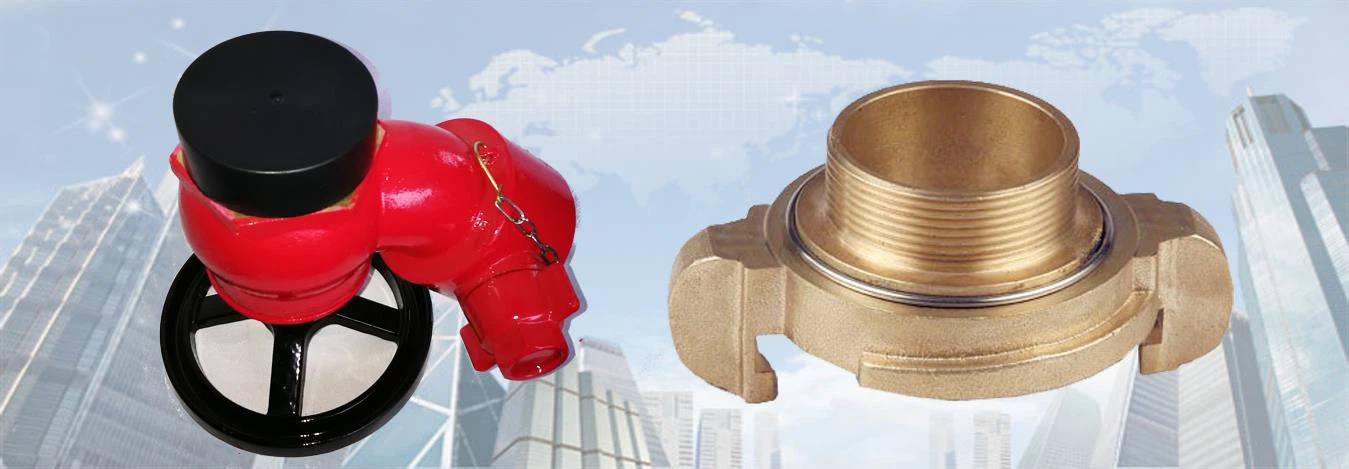
Fire Hydrant Valve
Hongye Fire is one of the best fire hydrant valve manufacturers & suppliers in China since 2000. As a China-based fire hydrant valve factory, we offer wide range fire hydrant valve products, such as Pressure Reducing Landing Valves, Fire Hydrant Angle Valves, Brass Gate Valve, Breeching Inlet Valve, Collecting and Dividing Breeching, Fire Hydrant Angle Valves. Our company can offer customized valves service according to your requirement too. Welcome to contact us for more information or request a fully product categolue.
-
![DN65 Pressure Reducing Landing Valve]() DN65 Pressure Reducing Landing Valve• Suitable for inlet pressure up to 20bar • Reduced outlet static pressure can be set from 5 to 8bar • Outlet pressure remain constant with inlet pressure range from 7bar to 20bar • Test...read more
DN65 Pressure Reducing Landing Valve• Suitable for inlet pressure up to 20bar • Reduced outlet static pressure can be set from 5 to 8bar • Outlet pressure remain constant with inlet pressure range from 7bar to 20bar • Test...read more -
![Pressure Regulating Fire Hydrant Landing Valve]() Pressure Regulating Fire Hydrant Landing Valve1. Product introduction of Pressure Regulating Landing Valve The landing valves are pressure reducing type designed to provide a range of outlet pressure (5 bar -8 bar). The Landing valves are...read more
Pressure Regulating Fire Hydrant Landing Valve1. Product introduction of Pressure Regulating Landing Valve The landing valves are pressure reducing type designed to provide a range of outlet pressure (5 bar -8 bar). The Landing valves are...read more -
![Right Angle Fire Hydrant Valve]() Right Angle Fire Hydrant Valve1.Product introduction Manufacturer of a wide range of products which include right angle pattern flanged valves. PN16 rated angled pattern fire hydrant valve with bronze body, suitable for both...read more
Right Angle Fire Hydrant Valve1.Product introduction Manufacturer of a wide range of products which include right angle pattern flanged valves. PN16 rated angled pattern fire hydrant valve with bronze body, suitable for both...read more -
![Straight Through Fire Hydrant Valves]() Straight Through Fire Hydrant Valves1.Product introduction Fire hydrant valves are suitable for both offshore and onshore application. They are manufactured to BS 5154 and BS 5041 part 1. For customers requiring a flanged inlet we...read more
Straight Through Fire Hydrant Valves1.Product introduction Fire hydrant valves are suitable for both offshore and onshore application. They are manufactured to BS 5154 and BS 5041 part 1. For customers requiring a flanged inlet we...read more -
![Oblique Type Fire Hydrant Valves]() Oblique Type Fire Hydrant Valves1.Product introduction Oblique Pattern Brass Screwed Fire Hydrant is a connector to fire water supply with the valve interface, used for factory, warehouse, public buildings and ship . 2.Product...read more
Oblique Type Fire Hydrant Valves1.Product introduction Oblique Pattern Brass Screwed Fire Hydrant is a connector to fire water supply with the valve interface, used for factory, warehouse, public buildings and ship . 2.Product...read more -
![Globe Fire Hydrant Valves]() Globe Fire Hydrant Valves1.Product introduction Valve be supplied as threaded valves,the threaded inlets are generally in BSP Parallel as standard but also can be supplied with BSP NPT, NH and most other thread options...read more
Globe Fire Hydrant Valves1.Product introduction Valve be supplied as threaded valves,the threaded inlets are generally in BSP Parallel as standard but also can be supplied with BSP NPT, NH and most other thread options...read more -
![Pressure Regulating Landing Valve]() Pressure Regulating Landing Valve1. Product introduction of Pressure Regulating Landing Valve The landing valves are pressure reducing type designed to provide a range of outlet pressure (5 bar -8 bar). The Landing valves are...read more
Pressure Regulating Landing Valve1. Product introduction of Pressure Regulating Landing Valve The landing valves are pressure reducing type designed to provide a range of outlet pressure (5 bar -8 bar). The Landing valves are...read more -
![Oblique Landing Valves]() Oblique Landing ValvesOblique landing valves are made of copper material with flanged inlet. It is used for automatic air discharge in water supply pipes in firefighting.read more
Oblique Landing ValvesOblique landing valves are made of copper material with flanged inlet. It is used for automatic air discharge in water supply pipes in firefighting.read more -
![Landing Valve For Wet Risers]() Landing Valve For Wet RisersOblique landing valves are made of copper material with flanged inlet. It is used for automatic air discharge in water supply pipes in firefighting.read more
Landing Valve For Wet RisersOblique landing valves are made of copper material with flanged inlet. It is used for automatic air discharge in water supply pipes in firefighting.read more -
![Pressure Reducing Valve]() Pressure Reducing Valve• Suitable for inlet pressure up to 20bar • Reduced outlet static pressure can be set from 5 to 8bar • Outlet pressure remain constant with inlet pressure range from 7bar to 20bar • Test...read more
Pressure Reducing Valve• Suitable for inlet pressure up to 20bar • Reduced outlet static pressure can be set from 5 to 8bar • Outlet pressure remain constant with inlet pressure range from 7bar to 20bar • Test...read more -
![Landing Valve Flange Type]() Landing Valve Flange TypeThis landing valve is an oblique flange type valve. It is made of copper with red painted body and black painted top. It is mainly used for fire hydrants.read more
Landing Valve Flange TypeThis landing valve is an oblique flange type valve. It is made of copper with red painted body and black painted top. It is mainly used for fire hydrants.read more -
![Fire Hose Angle Valve]() Fire Hose Angle Valve1.Product introduction of Fire Hose Angle Valve Angle hose valves are designed for use with a fire hose rack assembly, or, as a fire department outlet connection. Available in 11/2" and...read more
Fire Hose Angle Valve1.Product introduction of Fire Hose Angle Valve Angle hose valves are designed for use with a fire hose rack assembly, or, as a fire department outlet connection. Available in 11/2" and...read more


Fire hydrant valves are the core control devices of fire water supply systems, mainly used to open and close water flow, adjust pressure and connect fire equipment. As a key component of modern building fire protection facilities, their performance directly affects fire extinguishing efficiency. According to the standards of the International Fire Protection Association (NFPA), qualified fire valves must be able to maintain zero leakage at 1.1 times the working pressure and meet at least 30 full-open and full-close operation tests.
The core functions of fire hydrant valves
Control the opening and closing of water flow in the fire pipe network
Regulate the water supply pressure (0.2-1.6MPa)
Prevent water hammer effect from damaging the pipeline
Key interface for connecting fire hoses
What are the key performance requirements for fire hydrant valves?
High-quality fire valves must have the following features:
High-strength material: The valve body is usually made of ductile iron (QT450-10) or stainless steel (CF8M), with a tensile strength of ≥450MPa
Reliable sealing: The valve stem uses a double O-ring + graphite packing combination to ensure no leakage after 3000 operations
Quick operation: The opening and closing torque of the manual valve is ≤250N·m (DN150 specification), and it can be operated by one person in an emergency
Anti-corrosion treatment: The epoxy resin coating (thickness ≥250μm) has passed the 2000-hour salt spray test

Detailed explanation of the five major types of fire hydrant valves
1. Classification by structure
The mainstream fire valves on the market are divided into three categories: gate valves, butterfly valves, and ball valves:
The gate valve adopts a lifting gate structure, has full-diameter, low flow resistance characteristics (head loss <0.02MPa), and is suitable as a main valve for the main pipeline
The butterfly valve controls the water flow through a 90° rotating valve plate, has a fast opening and closing speed (<3 seconds), and its volume is only 1/3 of the gate valve of the same diameter
The ball valve is particularly suitable for high-pressure dangerous places such as liquefied gas stations due to its metal hard seal (leakage level VI).
2. Classification by drive mode
Manual valve: handwheel operation (requires ≥1.5m operating space)
Electric valve: remote control (response time <30s)
Hydraulic valve: large industrial facilities (thrust >10kN)
Pneumatic valve: explosion-proof area (ATEX certification)
3. By pressure level
Low pressure type (PN10): residential area
Medium pressure type (PN16): commercial building
High pressure type (PN25): petrochemical plant
Ultra-high pressure type (PN40): airport dedicated
4. Classification by material
| Material | Features | Life | Cost |
| Ductile cast iron | Compressive strength ≥420MPa | 25 years+ | $$ |
| Stainless steel 304 | Corrosion resistance/C1-C4 environment | 30 years | $$$ |
| Bronze Seawater | application/low friction | 20 years | $$$$ |
| Reinforced nylon | Lightweight/insulation | 15 years | $ |
5. Special function valves
Dry valve: antifreeze system (<0℃ environment)
Alarm valve: with pressure switch (linked fire host)
Pressure reducing valve: stable output pressure (high-rise building)
Anti-collision valve: underground design (driving area)
Q1: What are the main materials of fire hydrant valves? Which one is the most durable?
A: The mainstream materials are ductile iron (pressure resistant/cost-effective), stainless steel (corrosion resistant/lifespan of 30 years+) and bronze (applicable to seawater). Stainless steel 304/316 is recommended for industrial areas, and ductile iron can be selected for conventional environments.
Q2: How often do valves need to be maintained?
A: Manual opening and closing tests are performed quarterly, and seals are fully inspected every year. Key parts need to be supplemented with food-grade grease, and rubber seals must be replaced every 5 years.
Q3: How to choose between electric and manual valves?
A: Manual valves are low-cost but require manual operation (suitable for small places); electric valves support remote control (response <30 seconds), which is suitable for large facilities/unattended areas.
Q4: How to determine whether the valve needs to be replaced?
A: Replace immediately in the following situations:
• Valve body rust and perforation
• Operating torque exceeds the standard by 30%
• Pressure test leakage
• Used for more than 15 years (cast iron valve)
Q5: What precautions should be taken during installation?
A: Three key points:
The direction of the arrow is consistent with the water flow
Anti-collision protection cover is required for underground type
Pipe supports are installed on each side (spacing ≤3 meters)
Q6: How to prevent valve cracking?
A: Three solutions:
• Dry system design
• Install electric heating cable
• Drain the remaining water in the pipeline in winter
Q7: What is the flow rate of DN100 valve?
A: The standard Kv value is ≥120, and the flow rate is about 45L/s at 0.3MPa pressure (satisfying 2 19mm water guns to operate simultaneously).
Q8: What are the required certifications?
A: China requires CCCF, the United States UL/FM, and the European Union CE/PED. Special places such as petrochemicals also require API 607 fire protection certification.
Q9: Can it be used in corrosive environments?
A: Yes! Choose 316 stainless steel valve body + PTFE seal, or fluorine-lined valve. Bronze material is recommended for seawater environment.
We're one of the most professional fire hydrant valve manufacturers and suppliers in China, mainly engaged in wholesale service. Welcome to buy quality fire hydrant valve here from our factory.
Hydrant Landing Valve, Oblique Landing Valves, Fire Hydrant Air Release Valve